- Dice branch
- Dice · node V
- Played for dew · no cash value
Moth Muster
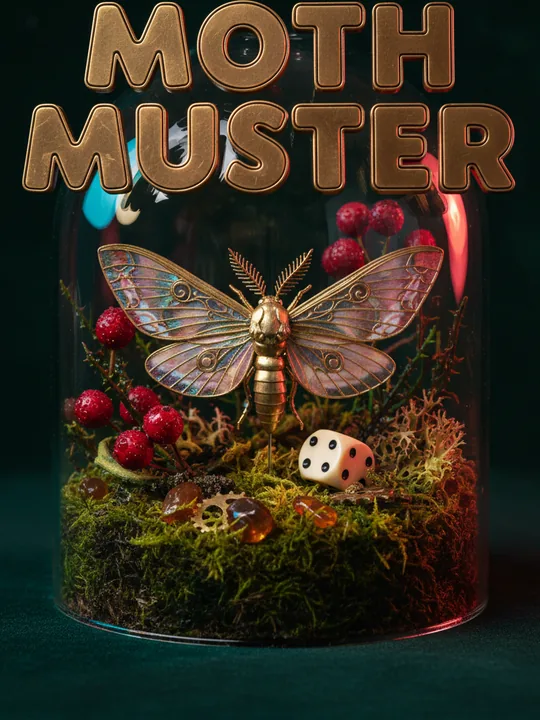
An old party dice game with a new insect: build a moth part by part from one die, in a fixed number of throws you choose before you start.

Pick a stake, then press Throw.
The games are resting.
A pause is on for this device.
The Library, the field notes and the Clearing stay open. See your settings.
About Moth Muster
Moth Muster borrows the shape of the beetle drives that used to fill church halls on winter evenings: one die, a body to build, and parts that only fit once the part they hang from is in place. Here the insect is a moth, and there is no table of friends to race; the moth only has to be finished before the throws run out.
The only choice is made before the first throw: the length. Brief is twelve throws, and a whole moth in twelve is rare enough to return a hundred times the stake. Long is twenty-four throws, where most moths get close to finished and the returns are smaller. Steady sits between them. The chance of each result is the same for everybody and does not change from round to round.
Watch the order in which parts arrive. Early on, a 6 is the only throw that matters; after that the 5 opens up the antennae and eyes. The tally of throws shows which ones added a part, so you can see how a moth came together, or why it never got its head.
How to play
- Pick a stake and a length: Brief (12 throws), Steady (18) or Long (24). Each length has its own column in the pay table.
- Press Throw. The die is thrown for you, one throw after another, until the throws run out or the moth is whole.
- A 6 gives the thorax. Nothing else can be added until the thorax is in place.
- With the thorax in place, a 5 gives the head and each 4 gives a wing, up to four wings.
- With the head in place, each 3 gives an antenna and each 2 gives an eye, two of each. A 1 never adds a part. The return depends on how many of the ten parts are in place at the end.
Chance of each result
Exact chances worked out from the rules, the same every round.
| Parts | Brief · 12 throws | Steady · 18 throws | Long · 24 throws |
|---|---|---|---|
| 10, the whole moth | 0.037 % | 2.6 % | 15.4 % |
| 9 | 0.4 % | 7.6 % | 19.4 % |
| 8 | 2.2 % | 13.8 % | 20.6 % |
| 7 | 6.1 % | 17.2 % | 16.1 % |
| 6 | 11.3 % | 16.4 % | 10.7 % |
| 5 | 15.2 % | 13.5 % | 7.0 % |
| 4 or fewer | 64.8 % | 29.0 % | 10.9 % |
Pay table
Every return is a multiple of your stake. Dew has no cash value and nothing here can be exchanged for anything.
| Parts | Brief · 12 throws | Steady · 18 throws | Long · 24 throws |
|---|---|---|---|
| 10, the whole moth | 100× | 12× | 3× |
| 9 | 30× | 4× | 1.4× |
| 8 | 10× | 1.6× | 0.8× |
| 7 | 4× | 0.6× | 0.3× |
| 6 | 1.8× | 0.1× | 0.1× |
| 5 | 0.8× | 0× | 0× |
| 4 or fewer | 0× | 0× | 0× |
Fair play
Every result comes from your browser's random number generator, through the rules above and nothing else. There is no hidden balancing, no streak memory and no change of odds after a quiet patch or a good run. The same pay table is read by the game and printed on this page.
Questions
Why does nothing happen until I throw a 6?
Every part hangs from the thorax, so the thorax comes first. That is the old rule of the game and it is the same for every round.
Which length is best?
None returns more than another over time. Brief swings most, Long least. Pick the one whose pace you enjoy.
Can I stop a round half way?
The throws run on their own and a round takes a few seconds, so there is nothing to stop. You can always stop between rounds.
At a glance
- Dice
- one six-sided die
- Lengths
- 12, 18 or 24 throws
- Parts
- thorax, head, 4 wings, 2 antennae, 2 eyes
- Order
- thorax first, then head and wings, then the rest
- Stakes
- 10 to 200 dew per round
- A round
- 3 to 5 seconds
Where to stop
Brief rounds feel close more often than they are: nine parts in twelve throws is uncommon, and ten is rarer still. If you find yourself switching lengths to chase a whole moth, it is a good time for a break.
Set a checkpoint